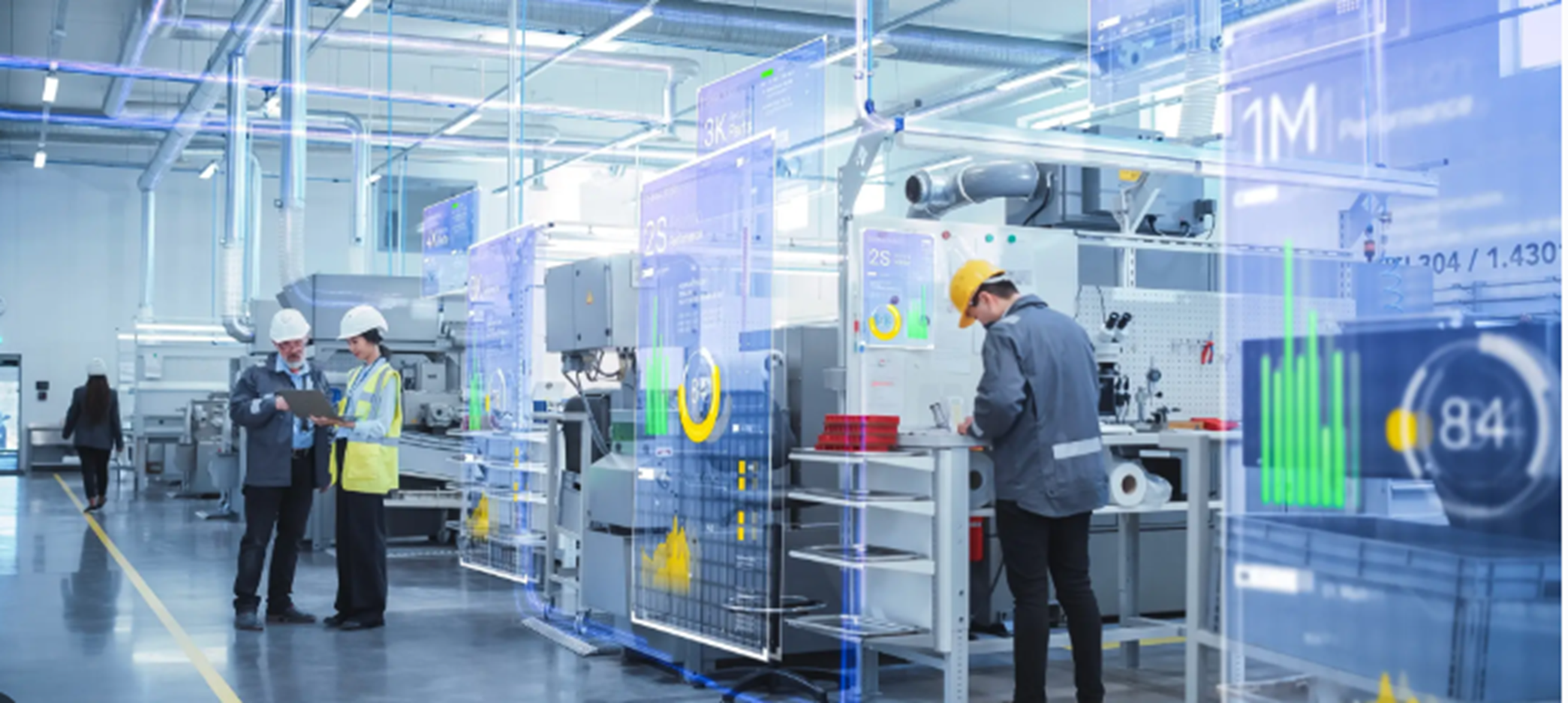
Smart Factory Digital Transformation Implementation for CPG Industry in Indonesia
Overview
A leading Consumer Packaged Goods (CPG) company in Indonesia initiated a Smart Factory Digital Transformation program to improve production productivity, enhance operational visibility, and reduce unplanned downtime. The project focused on integrating multi-vendor production equipment, establishing OT-IT connectivity, and implementing a centralized monitoring platform to support data-driven decision-making.
1. Business Challenge & Problem Definition
The customer operated multiple production lines consisting of machines with different technologies, automation platforms, and communication protocols. The existing condition created challenges in obtaining centralized production data and real-time operational visibility.
Key Challenges:
- Production machines used various automation technologies from different vendors and generations.
- Existing equipment required integration between Operational Technology (OT) and Information Technology (IT) environments.
- Additional sensors were required to capture critical production parameters for KPI and Overall Equipment Effectiveness (OEE) calculation.
- The customer required a centralized KPI Dashboard and HMI Monitoring System capable of monitoring all production equipment across the factory.
- Some legacy equipment did not support standard TCP/IP communication protocols.
- A dedicated OT network infrastructure compliant with cybersecurity requirements needed to be established.
- Production data needed to be stored in a centralized database accessible by global management teams.
2. Technology Solution
A comprehensive Smart Factory Digital Transformation solution was implemented by combining industrial connectivity, data integration, visualization, and historian capabilities.
Solution Components:
1. Industrial Data Acquisition & Sensor Integration
- Installation of additional sensors to capture critical production parameters.
- Development of custom solutions to collect machine performance data required for KPI and OEE measurement.
2. Multi-Vendor Machine Connectivity
- Implementation of industrial protocol converters to connect legacy and modern equipment.
- Integration of various PLC and automation systems regardless of manufacturer or communication protocol.
3. Industrial Communication Platform
- Implementation of OPC Kepware as a centralized connectivity layer.
- Standardization of machine data collection from multiple automation systems into a unified data structure.
4. Smart Factory Monitoring Platform
- Development of customized HMI, dashboard, and historian applications using Ignition by Inductive Automation.
- Real-time production monitoring across the entire factory.
- OEE calculation and KPI visualization.
- Historical data analysis and reporting.
- Centralized database integration for management reporting and global accessibility.
3. Solution Architecture
Production Machines & Sensors
↓
Protocol Converter & Industrial Gateway
↓
OPC Kepware Connectivity Layer
↓
Ignition Platform (HMI + Historian + Dashboard)
↓
Management KPI Dashboard & Reporting
4. Result & Business Impact
The Smart Factory implementation successfully transformed the production environment into a connected, data-driven manufacturing operation.
Key Benefits:
✅ Easy Operation & Centralized Monitoring
Operators and management teams gained real-time visibility of production performance through a centralized dashboard and HMI monitoring system.
✅ Optimized Production Performance
OEE monitoring and KPI analysis enabled faster identification of production losses, bottlenecks, and improvement opportunities.
✅ Reduced Downtime
Real-time machine condition monitoring and historical analysis helped improve troubleshooting response and minimize unplanned downtime.
✅ Optimized Human Resources
Centralized monitoring reduced manual monitoring activities and enabled operators to focus on higher-value operational tasks.
✅ Energy Consumption Monitoring
Integration of energy monitoring data provided visibility into energy usage and supported efficiency improvement initiatives.
✅ Global Data Accessibility
A centralized historian database enabled secure access to production performance information for global management teams.
Key Achievement Summary
Area
Machine Connectivity
Production Visibility
Performance Management
Data Management
Operational Efficiency
Reliability
Sustainability
Improvement
Integrated multi-vendor automation systems
Real-time factory-wide monitoring
Automated OEE & KPI calculation
Centralized historian database
Reduced manual monitoring workload
Reduced downtime and faster response
Energy consumption monitoring
Smart Factory Transformation Outcome
From isolated machines and manual monitoring → Connected, intelligent, and data-driven manufacturing operation.
The implementation established a strong foundation for future initiatives including Artificial Intelligence (AI), Predictive Maintenance, Advanced Analytics, and Industry 4.0 transformation