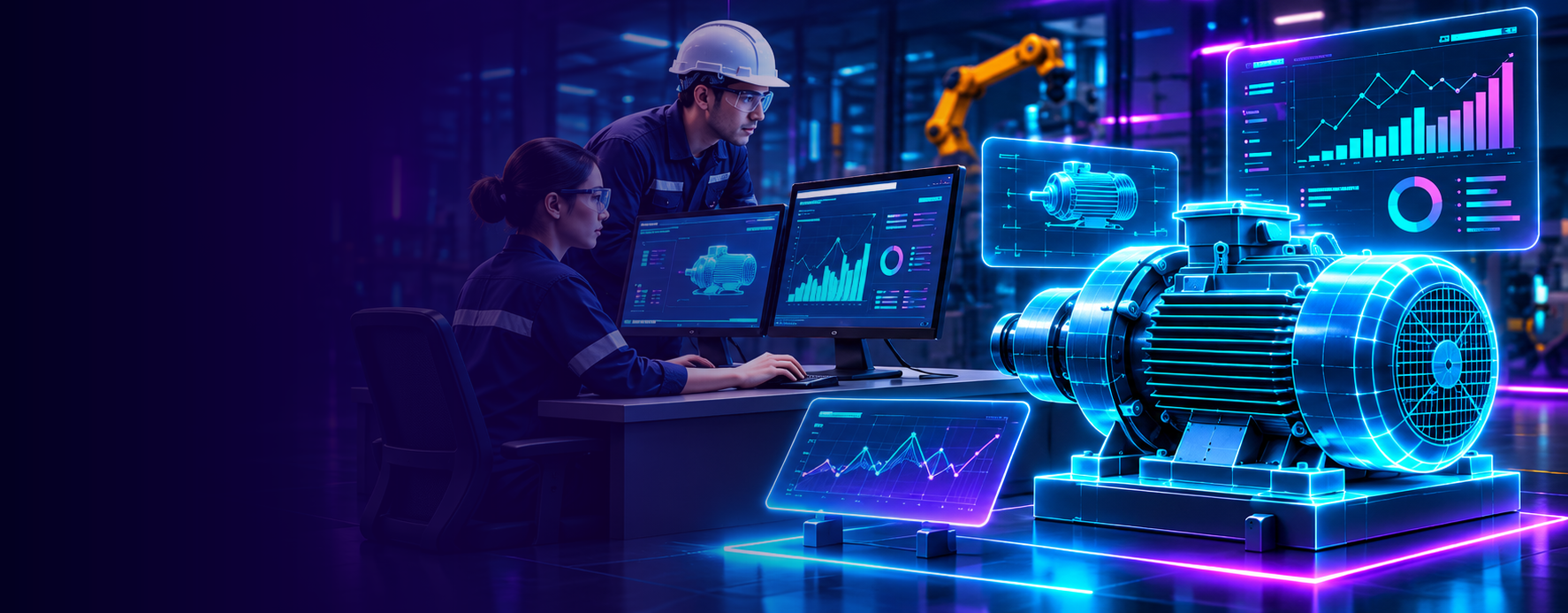
What if your plant could detect trouble before downtime?
Industrial AI can turn the data your plant already collects into early warnings, so teams act before a small deviation becomes an outage.
Most plants record process data around the clock: temperatures, pressures, flows, vibration, power. Yet much of it is reviewed only after something has gone wrong. A pump trips, a compressor shuts down, and engineers rebuild the story from historical trends.
Unplanned downtime affects production, maintenance cost and safety at the same time. The question worth asking is simple: what if the warning signs were already in the data days or weeks earlier?
From operational data to predictive intelligence
Industrial AI uses machine learning to learn what normal looks like for each asset and process, then flags behavior that starts to drift away from it. The inputs are the ones plants already have: historian and SCADA data, sensor readings, alarms and maintenance records.
This changes how maintenance and operations decisions are made:
- Reactive: act after the failure has happened.
- Preventive: act on a fixed calendar, whether or not the asset needs it.
- Predictive: act on the actual condition of the asset, at the right time.
The goal is not to replace engineers. It is to give them earlier, better-informed signals so decisions become more proactive.
Four capabilities that matter on the plant floor
SPC is building AI and machine learning capability around four use cases, each answering a different operational question.
The four work best together. Anomaly detection raises the first flag, RUL estimates how much time is left, and predictive maintenance turns that into a work order at the right moment.
Why engineering domain knowledge matters as much as the algorithm
A model trained on data alone can mislead. A change in feed quality, a planned shutdown or a recalibrated instrument can all look like an anomaly to an algorithm that does not understand the process.
This is where engineering domain knowledge changes the result:
- Framing the problem: engineers define which failure modes and process conditions are worth predicting.
- Preparing the data: process understanding guides tag selection, operating-mode filtering and data cleaning.
- Validating the output: predictions are tested against known events, not only statistical scores.
- Explaining alerts: operators trust a warning more when it points to a physical cause they can verify.
Combining domain knowledge with industrial data analytics is what turns a model into a decision-support tool.
How to start: a practical path
A first predictive use case does not need a plant-wide program. A focused pilot is usually enough to prove value:
- Pick one critical asset or process where downtime has a clear cost.
- Check the data: tag coverage, sampling rate, historian quality and maintenance records.
- Build a baseline model and test it against past events and failures.
- Run in shadow mode alongside operators to build trust before alerts go live.
- Integrate and scale: connect alerts to existing workflows, then extend to similar assets.
Predict today. Prevent tomorrow.
Industrial AI is most valuable when it supports better operational decisions, not when it adds another dashboard. SPC is developing AI and machine learning capabilities that combine engineering domain knowledge with industrial data analytics, helping plants move from reacting to problems toward preventing them.
If you want to explore where predictive intelligence could fit in your operation, start with one asset and one question: what would you want to know a week earlier?