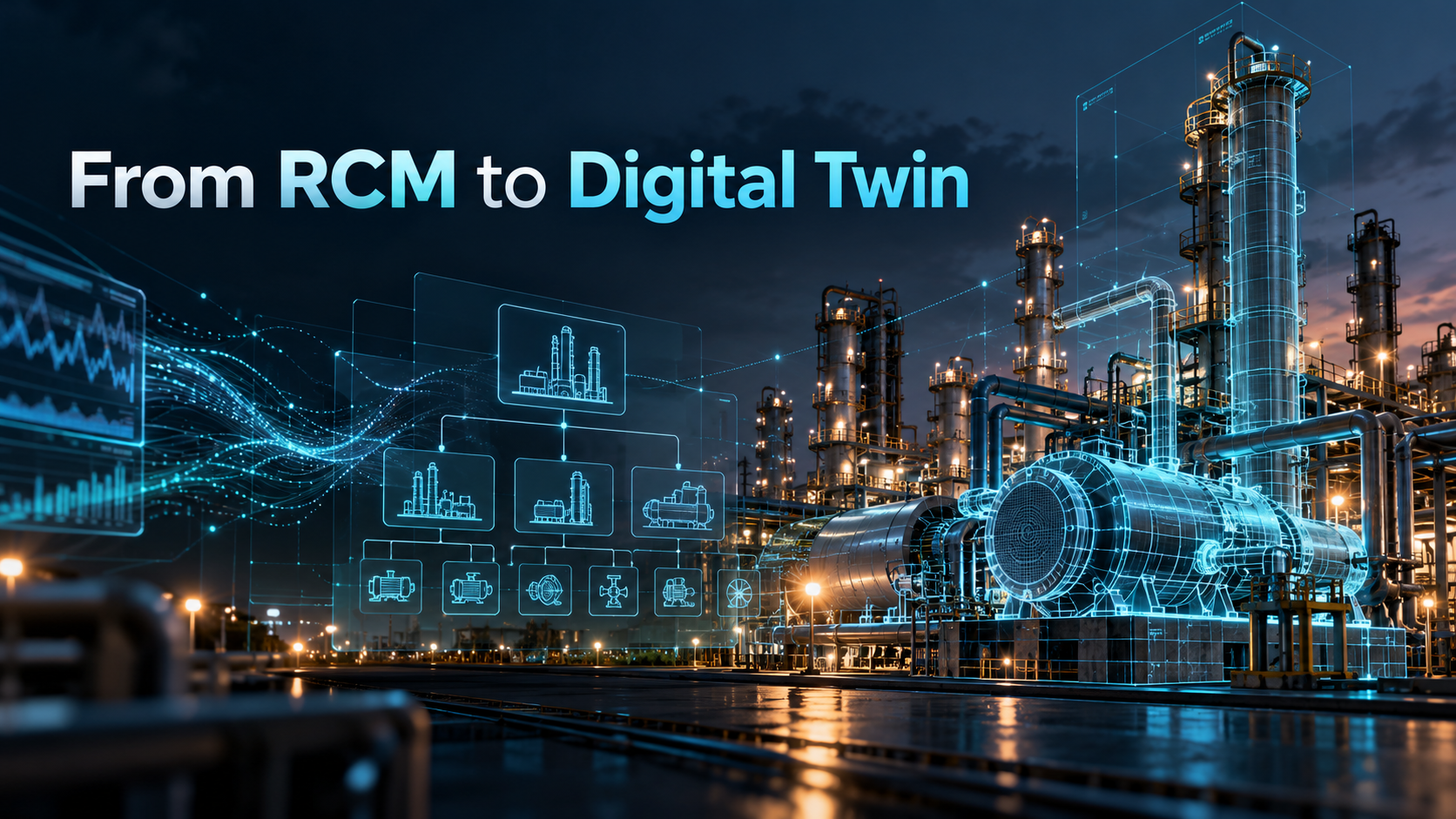
From RCM to Digital Twin: Building a Reliable Asset Foundation with AVEVA PI AF
How reliability context and a structured operational data model turn historian tags into a production facility digital twin
Many production facilities already collect large volumes of real-time data. Thousands of historian tags record pressures, temperatures, flows and valve positions every second. Yet engineers often struggle to answer simple questions quickly: which tags belong to this compressor, which instruments protect this scrubber, and which equipment is critical to reliability? The data exists, but the context does not.
A practical way to close this gap is to combine Reliability Centered Maintenance (RCM) with AVEVA PI Asset Framework (PI AF). RCM defines what the assets are and why they matter; PI AF turns that definition into a live, structured model connected to operational data. Together they form the foundation for a production facility digital twin.
1. RCM Defines the Asset and Reliability Context
The journey begins with the RCM asset register. Equipment, components, instruments and functional locations are organised in a hierarchy that follows the P&ID and the results of reliability analysis. Each record links a tag number to its description, equipment levels, sub-components, functional location, parent functional location and reference document number.
Because this hierarchy is built for maintenance and reliability, it already reflects how the plant is engineered and how it fails. It becomes the authoritative source of asset context, rather than a model invented from scratch for the data platform.
2. PI AF Transforms It into a Digital Asset Model
Next, the RCM hierarchy is implemented in PI AF. Every physical asset becomes an AF element, and similar assets share AF templates, so each one has a consistent structure and naming convention. The engineering hierarchy, previously held in a spreadsheet, becomes a navigable operational model.
In a gas processing facility, for example, the top-level area expands into systems such as chemical injection, condensate treatment, dehydration and mercury removal, fuel gas, flare and closed drain, inlet separation and produced water, and inlet and export compression.
3. Connecting System, Equipment and Operational Context
Within PI AF, equipment is organised by process system, train and individual unit. An inlet and export compression system, for instance, can be broken down into Export Compression Train A and Train B and Inlet Compression Train A and Train B, each containing its own compressors, scrubbers, coolers and valves.
This structure preserves the process relationships across the facility. Users can move from a whole system down to a single piece of equipment and immediately understand where it sits in the process.
4. Turning Historian Data into Contextualised Information
The real value appears when historian tags are mapped to the right equipment. Each AF element carries attributes that reference PI Data Archive tags, such as suction and discharge pressure, suction and discharge temperature, gas flow, scrubber temperature, vibration switches, shutdown valves and blowdown valves.
Instead of searching for cryptic tag names, an engineer opens the compressor element and sees every relevant parameter in one place, described in plain language. Operational data is now connected directly to the equipment it describes.
5. The Foundation for a Production Facility Digital Twin
A structured asset model combined with contextualised operational data delivers a reliable, integrated and future-ready digital twin foundation. On top of this layer, organisations can build:
- Asset performance management — tracking availability and performance by equipment and system.
- Condition monitoring — templated analyses and notifications applied consistently to similar assets.
- Predictive maintenance — combining reliability context with real-time trends to detect degradation early.
- Advanced analytics and industrial AI — feeding models with clean, well-labelled and correctly related data.
Summary of the Workflow
Conclusion
A digital twin is only as good as the context behind its data. By using RCM as the source of asset and reliability context and PI AF as the operational data model, facilities avoid building disconnected dashboards on top of unstructured tags. In short: RCM provides the context. PI AF makes it operational.
PT Scada Prima Cipta (SPC), an AVEVA and Schneider Electric partner, helps industrial clients in oil and gas, geothermal, power and manufacturing design and implement PI System asset models that turn reliability data into actionable operational insight.
