PI Server Migration: Are You Upgrading the System or Migrating the Problems?
A new PI Server doesn't always mean a better PI System.
What if you successfully upgrade your historian, but still face bad data, slow dashboards, and broken integrations?
From an engineering perspective, here are 5 common mistakes worth avoiding:
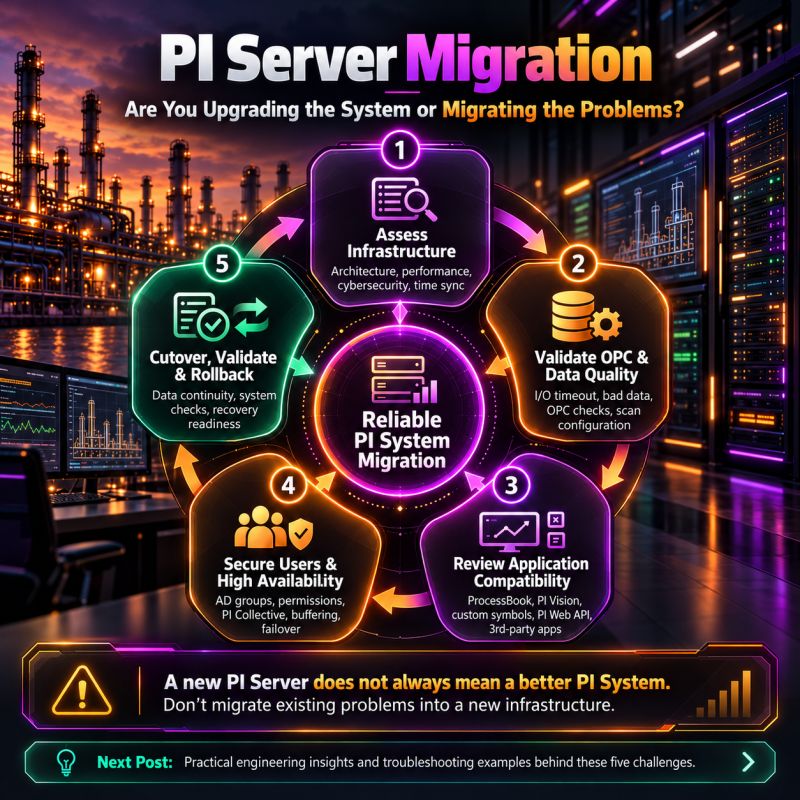
1️⃣ Skipping Infrastructure Assessment
Overlooking server performance, system architecture, OT cybersecurity, and time synchronization.
2️⃣ Ignoring OPC & Data Quality Issues
Migrating existing problems such as I/O Timeout, Bad Data, overloaded OPC Servers, and inefficient scan configurations.
3️⃣ Underestimating Application Compatibility
Missing dependencies involving PI ProcessBook, PI Vision custom symbols, PI Web API, and third-party integrations.
4️⃣ Overlooking Security & High Availability
Failing to validate Active Directory integration, user permissions, PI Collective, buffering, and failover.
5️⃣ Migrating Without Validation & Rollback
Assuming success without verifying data continuity, system performance, application functionality, and recovery readiness.
💡 The Engineering Lesson
Don't migrate existing problems into a new infrastructure.
A successful PI System migration isn't just about upgrading software. It's about improving data reliability, system performance, cybersecurity, and operational continuity.
Next Wednesday, I'll share practical engineering insights and troubleshooting examples behind these five challenges.
What's the biggest challenge you've encountered during a PI System migration?
#AVEVA #PISystem #PIServerMigration #IndustrialAutomation #OTCybersecurity #IndustrialData #DigitalTransformation