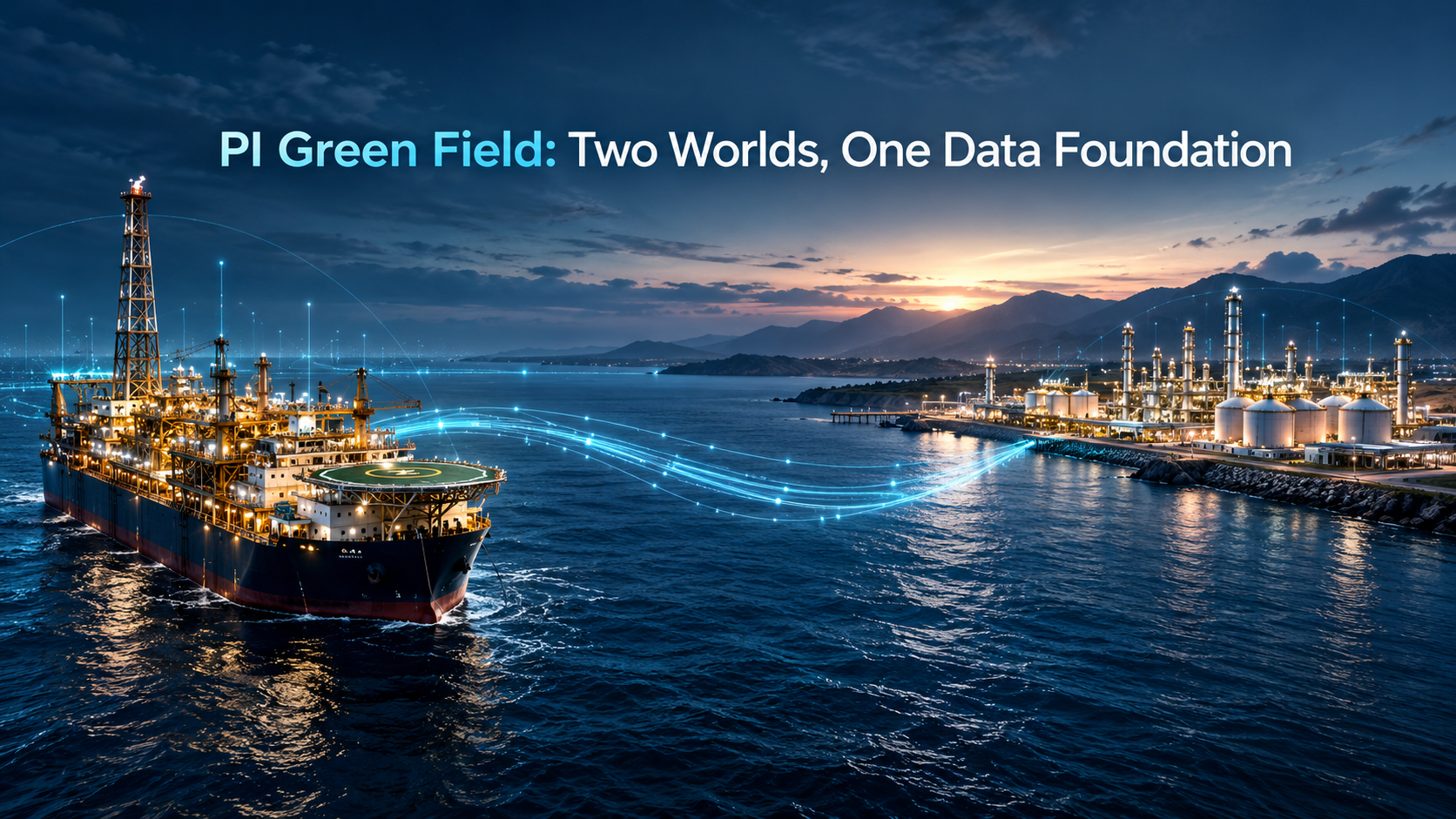
Two Worlds, One Data Foundation: Building a Greenfield AVEVA PI System from Offshore FPSO to Onshore Gas Plant
In a gas development, the offshore FPSO (Floating Production, Storage and Offloading vessel) and the onshore Central Gas Plant are separated by sea, subsea pipelines and long communication links. Operationally, however, they are one asset. Decisions about production, processing, safety and maintenance all depend on data flowing reliably between the two.
Our latest short video, PI Green Field, shows how a greenfield AVEVA PI System can be engineered as a single data foundation for both worlds, and why the time to do it is at the design stage, not after start-up.
Key takeaways
A greenfield project is the best moment to define how data is collected, secured, structured and validated.
Owner's engineering keeps DCS, SIS and AVEVA PI integration aligned with the owner's operational, cybersecurity and long-term business goals.
OT/IT architecture follows IEC 62443; asset data structure in PI Asset Framework follows ISO 14224.
FAT and SAT supervision confirms that the data reaching AVEVA PI is accurate, complete and continuous.
The result: real-time visibility in PI Vision, predictive maintenance and a platform ready for industrial AI.
Why the greenfield stage matters
On a brownfield site, data systems are often added on top of what already exists: tag names vary between vendors, network paths are improvised and historians are filled with data that nobody fully trusts. A greenfield project avoids that. From early design, the data foundation can be built for safe, efficient and sustainable operations, so the right data arrives in the right structure from the first day of production.
Owner's engineering: independent, experienced, on your side
On a large development, many contractors deliver many systems. The DCS (Distributed Control System) and SIS (Safety Instrumented System) vendors focus on their own scope. Someone has to look at the whole picture on behalf of the asset owner.
That is the role of owner's engineering. We represent the owner and make sure that DCS, SIS and AVEVA PI integration meets three sets of requirements at once: operational (operators and engineers get the data they need), cybersecurity (control and safety systems stay protected) and long-term business objectives (the system can grow with the asset over its life).
Secure OT/IT architecture aligned with IEC 62443
Data has to travel from the FPSO to shore without exposing control systems to risk. The architecture shown in the video follows a clear path:
- FPSO (offshore): the DCS and SIS generate process and safety data.
- Communication link: data travels over satellite, subsea fibre or MPLS networks through secure communication channels.
- Industrial DMZ: a firewalled buffer zone separates the control network from business networks, so no direct connection exists between them.
- Central Gas Plant (onshore): the AVEVA PI System, with the PI Data Archive storing high-resolution time-series data.
The design is aligned with IEC 62443, the international series of standards for the security of industrial automation and control systems. In practice, this means dividing the system into security zones, controlling the conduits between them and applying protection that matches the risk of each zone.
Standardized data and PI Asset Framework aligned with ISO 14224
Raw tags alone do not tell you much. A value such as “PT-2101.PV” only becomes useful when you know which equipment it belongs to and what it measures. We establish tag naming standards and build the PI Asset Framework (PI AF) using a hierarchy aligned with ISO 14224, the international standard for collecting and exchanging reliability and maintenance data for equipment in the petroleum, petrochemical and natural gas industries.
With every asset described the same way, monitoring, comparison between equipment and predictive analytics can be applied consistently across offshore and onshore facilities.
Integration assurance through FAT and SAT
A well-designed system still needs to be proven. We supervise the Factory Acceptance Test (FAT) and Site Acceptance Test (SAT) to make sure data from the FPSO and onshore systems reaches AVEVA PI accurately, completely and continuously. The checks cover five areas:
Operational visibility with PI Vision
Once the data is trusted, people can act on it. PI Vision delivers real-time operational visibility across the value chain, from the offshore FPSO to the onshore Central Gas Plant. Operators, engineers and managers see the same live data through web-based displays, wherever they are.
Predictive maintenance and industrial AI
A structured data foundation turns monitoring into prediction. The video shows a compressor train dashboard with an equipment health score and AI/ML anomaly detection on vibration, temperature, performance deviation and seal gas pressure. Because the data is already organized in PI AF, models built with tools such as Python can be applied to any similar asset without rework.
The outcome is condition-based maintenance and AI-driven insight: problems are found earlier, maintenance is planned around actual equipment condition and the asset achieves higher reliability at lower lifecycle cost.
The business value
Getting the data foundation right at the greenfield stage delivers four clear benefits:
- Reduced project risk and integration cost: fewer interface surprises during commissioning.
- Accelerated operational readiness: trusted data and displays are ready from first production.
- Scalable digital infrastructure: new wells, units or facilities can be added within the same structure.
- Industrial AI and higher asset reliability: analytics and machine learning have clean, structured data to work with.
Conclusion: build once, operate smarter, grow further
Offshore and onshore are two different worlds, but they should share one data foundation. By combining owner's engineering, a secure IEC 62443-aligned architecture, ISO 14224-based asset structure and rigorous FAT/SAT, a greenfield AVEVA PI System becomes the base for a safer, more reliable and more intelligent energy future.
Planning a greenfield oil and gas project? Contact SPC (PT Scada Prima Cipta) to discuss how we can help you engineer your data foundation from day one.
Frequently asked questions
What is a greenfield AVEVA PI System?
It is a PI System designed and built as part of a new facility, so data architecture, naming standards and asset structure are defined before the plant starts operating, instead of being added later.
What does owner's engineering mean in a PI System project?
An independent engineering team works on behalf of the asset owner to make sure that DCS, SIS and PI System integration from different contractors meets the owner's operational, cybersecurity and business requirements.
Why use IEC 62443 and ISO 14224?
IEC 62443 provides a recognized framework for securing industrial control systems. ISO 14224 provides a standard equipment hierarchy and data structure for reliability and maintenance data, which makes analytics consistent across assets.
What is checked during PI System FAT and SAT?
Typical checks include tag mapping, timestamp validation, data quality, interface performance and formal FAT/SAT verification, so data arriving in AVEVA PI is accurate, complete and continuous.
