Talking to Your Plant Data: AI + MCP for Industrial Historians
Oct 15, 2026 · @SPC
Getting answers from your plant historian is now as simple as asking a question. By connecting Generative AI to industrial data platforms through the Model Context Protocol (MCP), engineers can pull live time-series data, OEE metrics and statistical summaries in plain language, and get answers grounded in the plant's own records.
The Old Way: Hours Between a Question and an Answer
Pulling telemetry or OEE (Overall Equipment Effectiveness) figures out of an operational technology (OT) historian has traditionally meant one of three things: writing SQL queries by hand, navigating specialist client tools, or building custom REST API scripts. Each route needs someone who knows both the data model and the tooling.
The result is a familiar bottleneck. A plant manager asks a simple question about yesterday's line performance, and the answer waits in a queue behind the few people who know how to get it.
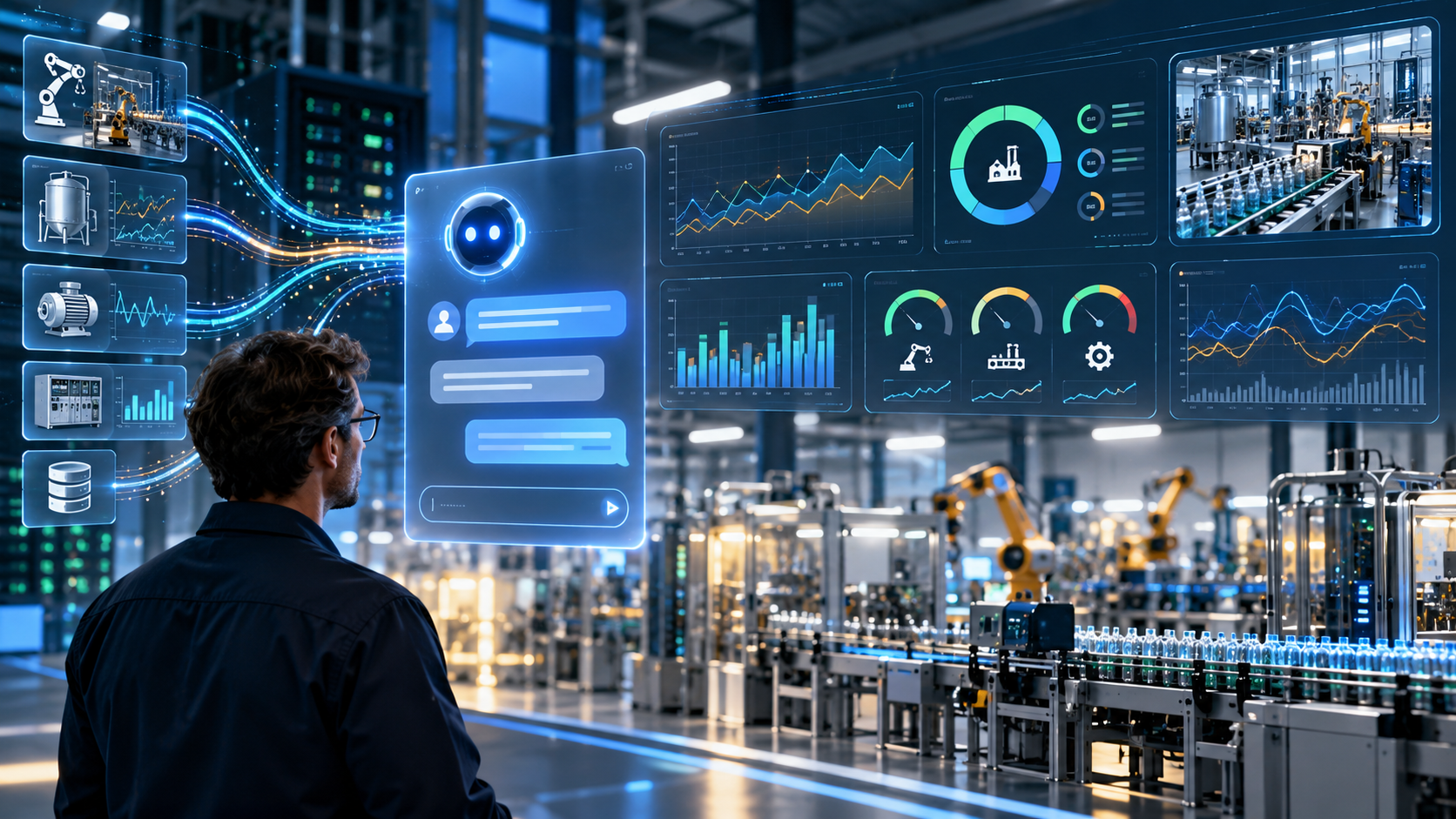
AI combined with MCP removes that bottleneck. MCP gives Large Language Models (LLMs) a standardized, controlled way to query and analyze live industrial data, so the question goes straight to the source.
What Is MCP, and Why Does It Matter for OT Data?
MCP is an open standard that defines how AI applications connect to external tools and data sources. Anthropic introduced it in November 2024, and in December 2025 donated it to the Agentic AI Foundation under the Linux Foundation, keeping it vendor-neutral.
Think of MCP as a universal adapter between an AI assistant and a historian. An MCP server sits in front of the data platform and exposes a set of well-defined tools, such as "find an asset", "read attribute values" or "calculate a summary". The AI never touches the database directly; it can only call the tools the server allows.
A typical request runs in four steps:
- Ask. The user types a question in plain language.
- Plan. The AI works out which tools to call and with which parameters (asset path, attribute, time range).
- Retrieve. The MCP server executes those calls against the historian and returns real data.
- Answer. The AI calculates, summarizes and visualizes the result, citing the data it received.
AI + MCP architecture for industrial historians
The AI only calls the tools each MCP server exposes; the data itself stays in IDMP or the PI System, read-only.
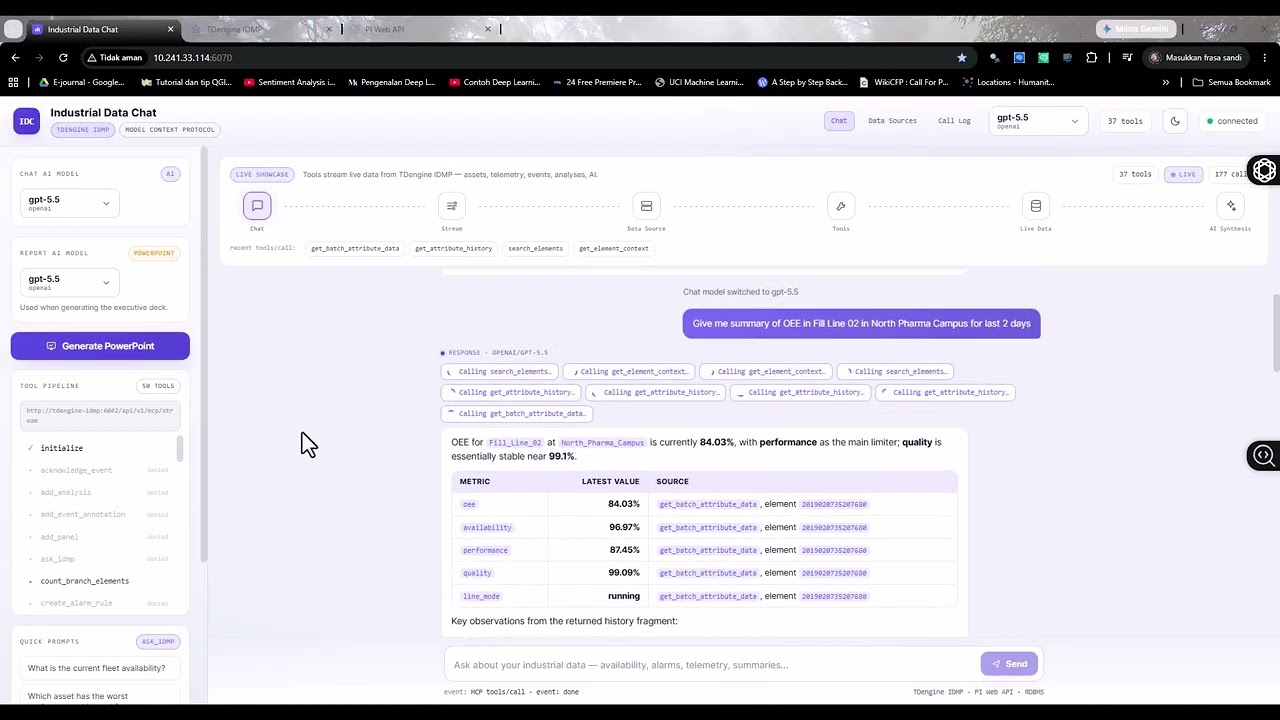
Example 1: OEE Analysis with TDengine IDMP (Native MCP Server)
TDengine IDMP exposes a built-in MCP interface through remote endpoints, so AI agents can reach its elements, attributes, events, analyses and dashboards without installing a separate MCP server.
Scenario: A production manager wants a quick view of how a filling line performed.
"Give me a summary of OEE for Fill Line 02 in North Pharma Campus."
What happens behind the scenes:
- The AI navigates the asset hierarchy to locate Fill Line 02 under North Pharma Campus.
- It calls the MCP tools that read the line's historical availability, performance and quality data.
- It combines them into the standard OEE breakdown.
\text{OEE} = \text{Availability} \times \text{Performance} \times \text{Quality}
Result: An OEE breakdown by component, a short trend summary and time-series charts, delivered in one conversational reply.
Example 2: Asset Telemetry from AVEVA PI System (PI AF + PI Web API via MCP)
AVEVA PI System is the historian behind many of Indonesia's oil and gas, geothermal, power and manufacturing operations. Its Asset Framework (PI AF) already organizes thousands of tags into a meaningful asset hierarchy, and PI Web API exposes that model over REST. An MCP server built on top of PI Web API lets an AI assistant work with the same context engineers use every day.
Scenario: An engineer needs a fast statistical view of one attribute.
"Give me summary data and a line chart for Ramp1 in Element5."
What happens behind the scenes:
- The AI resolves Element5 in the PI AF hierarchy and finds its Ramp1 attribute.
- It retrieves the attribute's recorded values for the requested period through PI Web API.
- It calculates the key statistics (average, minimum, maximum and standard deviation).
Result: A statistical summary and an interactive line chart, rendered directly in the chat window.
Why AI + MCP Is a Game-Changer for Industry 4.0
Before vs after: the path from question to answer
- Data democratization. Process engineers, plant managers and maintenance teams can get OT insights in plain language, without learning SQL, APIs or historian client tools.
- Speed to insight. Questions that used to wait hours for a specialist are answered in seconds, while the issue is still on the table.
- Grounded intelligence. Answers are built from verified plant data returned by the historian, not from the model's general knowledge, which greatly reduces the risk of AI hallucination.
- More value from existing investments. MCP builds on the asset models, tags and calculations already in PI AF or IDMP. There is no need for a new data lake before getting started.
Built for OT: Security and Governance First
Connecting AI to plant data is only valuable if it is done safely. A well-designed industrial MCP deployment follows the same principles as any OT integration:
- Read-only by design. The MCP server exposes query and analysis tools only. It has no path to write values back to the historian or the control system.
- Respect the network segmentation. The AI connects to PI Web API or IDMP at the IT or DMZ level, typically on a replicated historian, never directly to the control network.
- Least-privilege access. A dedicated service account with mapped permissions limits which assets and attributes the AI can see.
- Full traceability. Every tool call, parameter and result can be logged, so any answer can be traced back to the data behind it.
- People stay in the loop. AI speeds up analysis, but operational decisions remain with engineers and operators.
How SPC Can Help
As an AVEVA and Schneider Electric system integrator, PT Scada Prima Cipta (SPC) designs, implements and supports PI System solutions for oil and gas, geothermal, power and manufacturing clients across Indonesia. We help you bring AI + MCP to your plant data, step by step:
- Readiness review. Check the quality of your PI AF or IDMP asset model, data access and network architecture.
- Secure MCP integration. Build and deploy a read-only MCP server on PI Web API or IDMP, aligned with your IT-OT segmentation and cybersecurity policies.
- Pilot use case. Prove value on one real question, such as OEE, energy consumption or equipment health, before scaling up.
- Rollout and training. Extend to more assets and users, and train your team to get the most from conversational analytics.
Ready to talk to your plant data? Contact the SPC team to arrange a live demo with your own PI System or industrial data platform.
Sources:TDengine IDMP MCP Interface documentation · Model Context Protocol (Wikipedia) · Anthropic: Donating MCP to the Agentic AI Foundation